
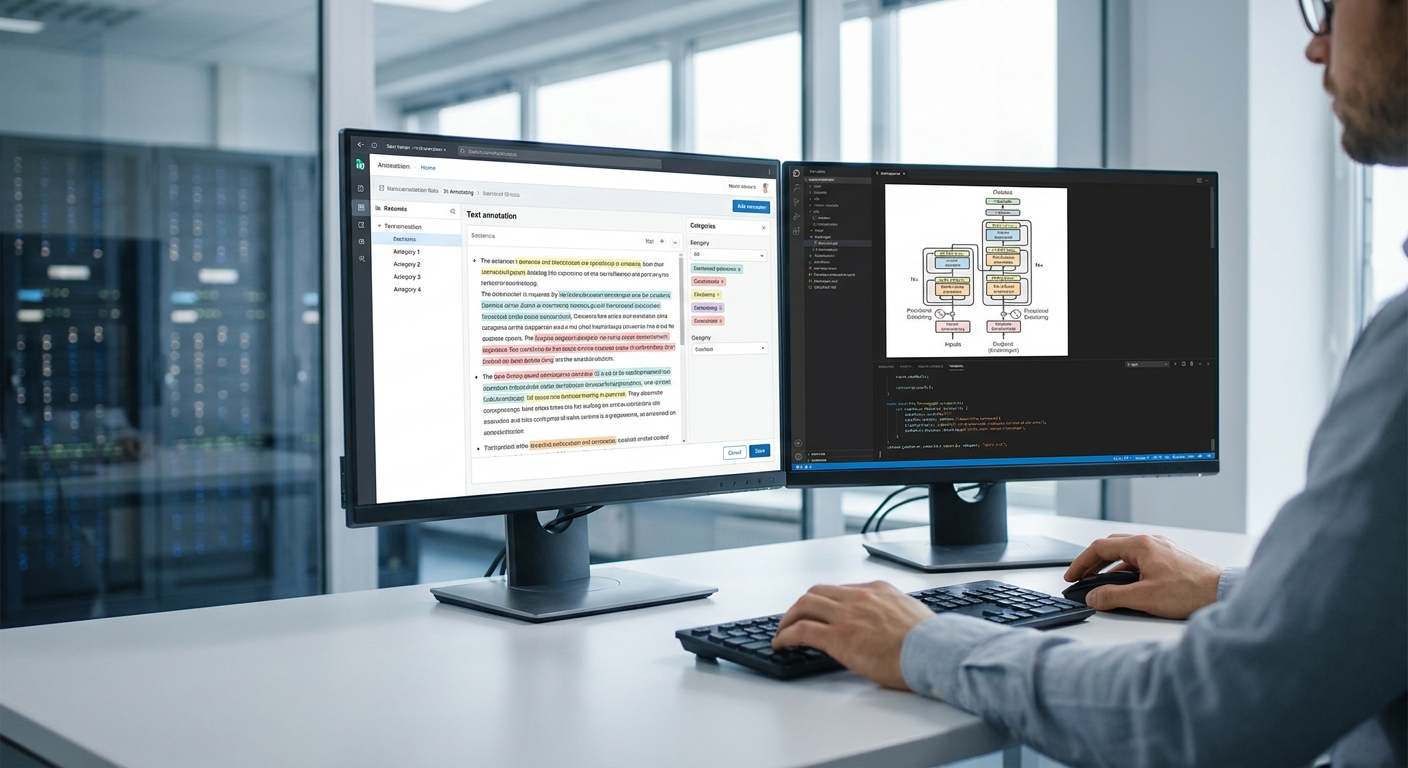
Picking the wrong data labeling setup for LLM fine-tuning costs you months, not dollars — annotator turnover, inconsistent guidelines, and reward hacking show up in your eval scores long before anyone catches the root cause.
- Rapidata's API/SDK platform wins for teams running RLHF pipelines that need 5K+ annotations per minute — Buy.
- In-house labeling teams work for under 10K labels but stall past that volume — Consider only at small scale.
- Generic freelance marketplaces are the cheapest option but lack reward-hacking safeguards — Skip for preference data.
- Enterprise annotation vendors handle large static datasets well but move slower on iterative RLHF loops — Hold.
Why this matters
Fine-tuning an LLM in 2026 means feeding it human preference signal, not just labeled examples — the annotation layer decides whether your reward model actually reflects what people want or just what's easy to game. Data labeling for LLM fine-tuning has shifted from static classification tasks to live RLHF preference collection, and most legacy labeling setups weren't built for that shift.
Rapidata's API and SDK platform runs crowd-sourced human feedback — labeling, model evaluation, and RLHF preference data — through 30M+ annotators across 192 countries, built specifically for teams training and evaluating ML models. That's the baseline this guide compares against.
Who this is for
This is for ML engineers and applied researchers fine-tuning an LLM who need human preference data, not just ground-truth labels — teams building reward models for RLHF, running A/B evaluations between checkpoints, or annotating datasets at a scale their internal team can't cover alone.
What to look for in data labeling for LLM fine-tuning
Annotator scale and diversity
A reward model trained on 200 annotators from one country will overfit to that population's preferences fast. Rapidata's network spans 192 countries, which matters when your model ships to a global user base and needs preference data that isn't skewed toward one demographic.
Throughput under load
RLHF loops need fast turnaround between training runs, not a two-week annotation cycle. Platforms delivering 5K+ annotations per minute let you iterate on a checkpoint the same day instead of waiting on a labeling queue.
Reward-hacking resistance
Any reward model that annotators — or the model itself — can learn to game defeats the purpose of RLHF. Look for a labeling methodology built around preference collection that resists gaming, not just a QA pass after the fact.
API and SDK integration
Manual CSV exports and Slack threads with a labeling vendor don't scale past your first fine-tuning run. A Job Definition you can call from your training pipeline via API/SDK cuts the loop from weeks to days.
Volume elasticity
Your labeling need in month one won't match month six. A vendor that's processed 671M+ annotations total has the annotator pool to scale from a 10K-sample pilot to a multi-million-annotation production run without a re-negotiation.
RLHF-specific preference data
Generic labeling vendors label images or text against a rubric. RLHF needs pairwise preference judgments, ranking data, and evaluation feedback formatted for reward model training — a different deliverable entirely.
Top picks
In-house labeling team — the slow burn. Your own annotators, managed on spreadsheets or an internal tool. One spec that matters: turnaround scales linearly with headcount, so a 50K-annotation batch takes roughly 10x longer than a 5K batch with the same team. Fine for a first pilot under 10K labels. Past that, coverage gaps and reviewer fatigue creep in. Consider for early-stage validation only.
Generic freelance marketplace — the budget option. Platforms built for general-purpose micro-tasks, not RLHF preference collection. The spec that matters: no built-in reward-hacking safeguards, so annotators can learn to pattern-match toward whatever gets tasks approved fastest. Cheap per label, expensive in retraining cycles once you catch the drift in your eval set. Skip for preference data; usable for basic classification only.
Enterprise annotation vendor — the incumbent. Large-scale vendors built for static dataset labeling — image tagging, document classification, that kind of volume. The spec that matters: strong at one-time bulk labeling jobs, slower on the iterative back-and-forth RLHF training loops demand, since their workflows assume a single delivery, not continuous rounds. Hold if you're mid-training and need same-week turnarounds between checkpoints.
Rapidata API/SDK platform — the API-first pick. Crowd-sourced human feedback delivered through a Job Definition you call directly from your training code, drawing on 30M+ annotators and 671M+ annotations collected to date. The spec that matters: 5K+ annotations per minute of throughput, with a reward model methodology built specifically to resist gaming. Results land in minutes to days instead of weeks. Buy for any team running active RLHF fine-tuning in 2026.
What to avoid
- Vendors that label but don't rank. A platform that returns single-item labels instead of pairwise preference or ranking data can't feed an RLHF reward model — you'll end up reformatting the output yourself.
- Annotator pools with no geographic spread. A US-only or single-market annotator base bakes a narrow set of preferences into your reward model, which surfaces as bias once the model ships internationally.
- "Bulk delivery" pricing models. If the vendor quotes one price for one large batch with no support for iterative re-runs, you're locked into a workflow that doesn't match how fine-tuning actually happens — in rounds, not one shot.
Verdict comparison
| Option | Throughput | Annotator scale | RLHF-ready | 2026 Verdict |
|---|---|---|---|---|
| In-house team | Low, headcount-bound | Small, single-market | Manual setup needed | Consider (pilot only) |
| Freelance marketplace | Variable | Broad but unvetted | Weak on gaming resistance | Skip |
| Enterprise vendor | Moderate, batch-based | Large, static | Built for one-time labeling | Hold |
| Rapidata API/SDK | 5K+ per minute | 30M+ across 192 countries | Built for preference data | Buy |
Get RLHF-ready labeling data
Call the Rapidata API and collect human preference data in days, not weeks.
FAQ
What is data labeling for LLM fine-tuning?
Data labeling for LLM fine-tuning is the process of collecting human-generated labels, rankings, or preference judgments used to train or align a language model. In 2026 this increasingly means RLHF preference data — pairwise rankings and evaluation feedback — rather than simple classification tags.
Is Rapidata better than a freelance marketplace for RLHF data?
Yes, for preference data specifically. Rapidata's platform is built around reward model methodology designed to resist gaming, while generic freelance marketplaces have no built-in safeguard against annotators pattern-matching toward approval.
How fast can you get labeled data for a fine-tuning run?
Through an API/SDK platform like Rapidata, annotation throughput can reach 5K+ annotations per minute, turning a labeling job around in minutes to days instead of the multi-week timelines typical of manual vendor workflows.
Do I need a diverse annotator pool for RLHF?
Yes — a reward model trained on preference data from one country or demographic will reflect that group's biases. Platforms with annotator networks spanning 192 countries reduce that skew.
Can an in-house team handle LLM fine-tuning labels?
An in-house team works for small pilots under roughly 10,000 annotations but stalls at production scale since turnaround time scales directly with headcount, not with the tooling.
What's the difference between labeling and RLHF preference data?
Standard labeling assigns a single tag or category to an item. RLHF preference data requires humans to rank or compare model outputs against each other, producing the pairwise signal a reward model needs to train on.
How many annotations does a fine-tuning run typically need?
Volume varies by task, but production RLHF pipelines commonly run from tens of thousands to millions of annotations — Rapidata's platform has processed 671M+ annotations across client workloads to date.
Does an API-based labeling platform integrate with existing training pipelines?
Yes, platforms built around a Job Definition and SDK let you call annotation jobs directly from training code, removing the manual export/import step that slows down iterative fine-tuning rounds.
One last thing
The detail most teams miss: a reward model that can be gamed is worse than no reward model at all, because it actively trains your LLM toward the wrong behavior with high confidence. Check whether your labeling methodology accounts for that before you scale past a pilot batch in 2026 — retraining after the fact costs far more than getting the annotation layer right the first time.